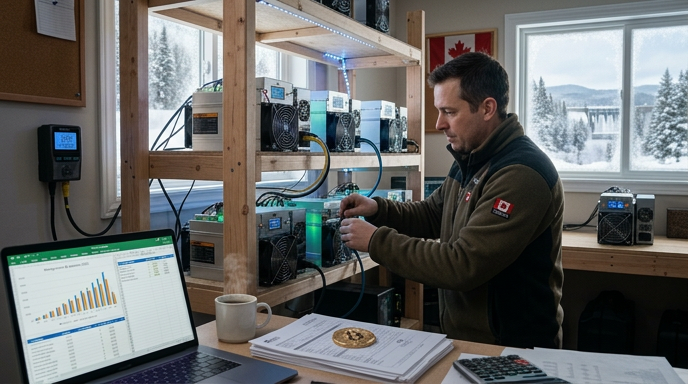
Bitcoin mining in Canada 2026: Home and Small-Scale Mining Profitability, Electricity Costs, and CRA Tax Rules
Bitcoin mining in Canada 2026 is an increasingly specialized activity. This guide explains how to evaluate home and small-scale mining profitability, estimate electricity costs by province, understand noise and permitting constraints, and meet Canada Revenue Agency reporting obligations. If you are evaluating whether to buy an ASIC miner or repurpose hardware for hobbyist mining, this article gives practical steps, sample calculations, and Canadian-specific considerations to make an informed decision.
Table of Contents
- Table of Contents
- Is mining right for you?
- Profitability basics and example calculation
- Core formula
- Worked example (illustrative)
- Electricity costs by province and how they affect returns
- Hardware options: ASIC vs GPU vs cloud mining
- Step-by-step set up for home/small-scale mining
- Permits, noise, building rules, and safety
- CRA tax treatment and reporting - practical steps
- Risk management, power outages, and exit strategies
- FAQ
- 1. Is small-scale Bitcoin mining profitable in Canada?
- 2. Do I need a business license to mine at home?
- 3. How does the CRA tax mined bitcoin?
- 4. Should I host miners in a data centre or mine at home?
- 5. Can I mine during winter and reuse the heat?
- 6. Are second-hand ASICs worth buying?
- Conclusion and actionable takeaways
Table of Contents
- Is mining right for you?
- Profitability basics and example calculation
- Electricity costs by province and how they affect returns
- Hardware options: ASIC vs GPU vs cloud
- Step-by-step set up for home/small-scale mining
- Permits, noise, building rules, and safety
- CRA tax treatment and reporting - practical steps
- Risk management, power outages, and exit strategies
- FAQ
- Conclusion and actionable takeaways
Is mining right for you?
Ask these first: are you mining to earn bitcoin directly, to reuse heat in a workshop or greenhouse, or to speculate on short-term returns? Home and small-scale mining often have thin margins once electricity, equipment, and time are included. Evaluate opportunity cost: buying BTC directly (DCA) is often simpler and lower risk. If you pursue mining, treat it as a small business plan: measure expected revenue, costs, and regulatory obligations before purchasing hardware.
Profitability basics and example calculation
Profitability depends on hashrate, power consumption, miner efficiency (J/TH), bitcoin block reward and fees, pool fees, and electricity cost. Use a reputable mining calculator, but understand the underlying math so you can stress-test scenarios.
Core formula
Expected BTC/day = (your_hashrate / total_network_hashrate) * BTC_block_reward_per_dayThen convert BTC/day to CAD using current spot price and subtract operating costs (electricity + pool fees + maintenance). Example simplified calculation:
Revenue_CAD_per_day = BTC_per_day * BTC_price_CAD
Electricity_cost_per_day = (power_Watts / 1000) * hours_per_day * electricity_price_per_kWh
Profit_per_day = Revenue_CAD_per_day - Electricity_cost_per_day - Pool_fees
Worked example (illustrative)
- ASIC miner: 100 TH/s, 3000 W, efficiency 30 J/TH.
- Network share: estimate BTC/day from calculator (varies). For our example assume 0.0002 BTC/day.
- BTC price = 80,000 CAD (example); revenue = 0.0002 * 80,000 = 16 CAD/day.
- Electricity: 3 kW * 24 h = 72 kWh/day. At 0.15 CAD/kWh = 10.80 CAD/day.
- Pool fee and maintenance: 2 CAD/day. Profit = 16 - 10.8 - 2 = 3.2 CAD/day.
This simplified example shows narrow margins and exposure to BTC price and difficulty changes. Always run sensitivity scenarios for difficulty increases, BTC price drops, and downtime.
Electricity costs by province and how they affect returns
Electricity is the largest ongoing cost. Provincial rates, time-of-use pricing, and commercial rates vary widely. Approximate residential retail ranges (subject to change) are:
- Quebec and Manitoba - typically among the lowest retail rates (often below 0.10 CAD/kWh in many areas).
- Ontario and British Columbia - moderate rates with time-of-use pricing; residential peaks can be 0.15-0.25 CAD/kWh.
- Alberta and some Atlantic provinces - more volatile rates, potentially higher for residential customers; commercial options may be cheaper if demand charges apply.
Key actions:
- Check your last electricity bill for kWh price and time-of-use blocks.
- Request commercial rates if you expect sustained high load - commercial tariffs and demand charges can change economics.
- Factor in distribution and delivery fees, taxes, and any net-metering credits if you pair mining with behind-the-meter generation.
Hardware options: ASIC vs GPU vs cloud mining
Choose the right approach for your goals:
| Option | Pros | Cons | Best for |
|---|---|---|---|
| ASIC miners | Highest efficiency and hash density | High upfront cost, noisy, limited resale markets | Dedicated small-scale mining with access to low electricity rates |
| GPU rigs | Flexible (mine other coins), resale options | Less efficient for SHA-256 than ASICs, higher power per hash | Hobbyists, learning, dual-utility setups |
| Cloud mining/Hosting | No local power or noise, maintenance offloaded | Counterparty risk, opaque contracts | Avoiding local permitting or when you cannot access cheap power |
Step-by-step set up for home/small-scale mining
- Calculate break-even using local electricity prices and multiple BTC price/difficulty scenarios.
- Choose hardware and verify local noise, ventilation, and power capacity. For multiple ASICs confirm panel amperage and breaker ratings with a licensed electrician.
- Select a mining pool or decide to solo mine. Pools reduce variance but charge fees.
- Plan cooling and airflow. Avoid recirculating hot air into the miner intakes; consider exhaust to outdoors if feasible.
- Plan firmware and security: run miners behind a router with management VLANs, change default passwords, and keep management interfaces off the public internet where possible.
- Decide where mined bitcoin will flow: direct to a noncustodial wallet you control for self-custody, or to an exchange if you intend to sell. If you plan self-custody, use best practices for address reuse and seed security.
Permits, noise, building rules, and safety
Mining at home may trigger local bylaws, strata rules, or lease restrictions. Common issues:
- Noise complaints from continuous fan noise in residential zones.
- Strata or condo rules restricting business use or high electrical loads.
- Insurance policies that exclude business activities conducted at home - consult your insurer.
- Electrical safety hazards if circuits are overloaded - always use a licensed electrician.
If you need more resilience during outages, see practical steps in Bitcoin during blackouts for household resilience — but note mining requires sustained power and is not an ideal backup use-case.
CRA tax treatment and reporting - practical steps
The Canada Revenue Agency treats bitcoin received from mining as income at the fair market value in CAD when it is received. Many small-scale miners are considered to be carrying on a business, which affects whether mining expenses can be deducted. Practical steps:
- Record each mined reward in CAD at the time of receipt. Keep timestamps, exchange rates, and pool statements.
- Track deductible expenses separately: electricity, hardware (capital asset), repairs, internet, and a proportion of home office or space costs where applicable.
- When you later sell mined BTC, the disposition may trigger capital gains or business income treatment depending on how CRA views your overall activity. Read the CRA reporting fundamentals in depth: CRA Bitcoin Tax Reporting guide.
- Consider registering for GST/HST if your mining activity is a commercial enterprise and you meet the registration threshold; consult an accountant familiar with crypto taxation.
- Keep robust records. Use spreadsheets, export pool or exchange CSVs, and timestamp on-chain receipts when possible.
If you also operate a full node to validate your own coinbase payouts and privacy, see how to run a Bitcoin full node in Canada for setup and reliability tips.
Risk management, power outages, and exit strategies
Key risk controls:
- Stress-test profitability for BTC price drops and difficulty increases. Use worst-case assumptions to determine maximum pain points before shutdown.
- Plan an exit: choose hardware with strong resale demand, document serial numbers, and maintain original boxes to preserve value.
- Prepare for outages: mining typically stops during power interruptions. For continuity of wallet access and security during outages, refer to household blackout planning resources including the guide on blackouts linked earlier.
- Insure heavy setups if feasible — speak with insurers about business-property coverage; many homeowner policies exclude business activities.
FAQ
1. Is small-scale Bitcoin mining profitable in Canada?
It can be in regions with low electricity costs and access to efficient hardware, but margins are narrow and risk is high. Always run sensitivity analyses for BTC price and network difficulty changes.
2. Do I need a business license to mine at home?
Local rules vary. Mining can be considered a home-based business in some municipalities or by strata rules. Check local bylaws and lease/condo rules before operating at scale.
3. How does the CRA tax mined bitcoin?
Mined bitcoin is income at the fair market value in CAD when received. Expenses related to a business operation may be deductible. For full guidance, see the CRA reporting walkthrough in the linked guide above.
4. Should I host miners in a data centre or mine at home?
Hosting offsite reduces noise, permits, and electricity complexity but adds hosting fees and counterparty risk. Compare total cost of ownership for both options before deciding.
5. Can I mine during winter and reuse the heat?
Many hobbyists reuse miner heat for workshops or greenhouses, but ensure safety and compliance. Heat reuse can improve total energy utility, but it does not change electricity costs or tax treatment of mined BTC.
6. Are second-hand ASICs worth buying?
Used ASICs lower upfront cost but may have reduced lifespan and warranty. Check hashrate, power draw, and seller reputation. Factor in shipping and import duties if buying from outside Canada.
Conclusion and actionable takeaways
Home and small-scale Bitcoin mining in Canada is feasible but requires careful planning. Action checklist:
- Run detailed break-even scenarios including electricity, pool fees, and difficulty sensitivity.
- Verify local bylaws, condo/lease rules, and ensure electrical capacity with a licensed electrician.
- Set up security best practices for miner management and decide on direct self-custody flows for mined BTC.
- Keep meticulous records for CRA reporting and track CAD value at time of receipt; consult a crypto-aware accountant.
- Prepare an exit plan: choose hardware with resale demand or consider hosted solutions to reduce local complexity.
Mining remains a capital-intensive, operationally demanding way to acquire bitcoin. For many Canadians, buying bitcoin directly and focusing on self-custody, multisig backups, and tax-compliant recordkeeping will be a simpler path to exposure. If you proceed to mine, treat it like a small business: measure, document, protect, and plan your exit.